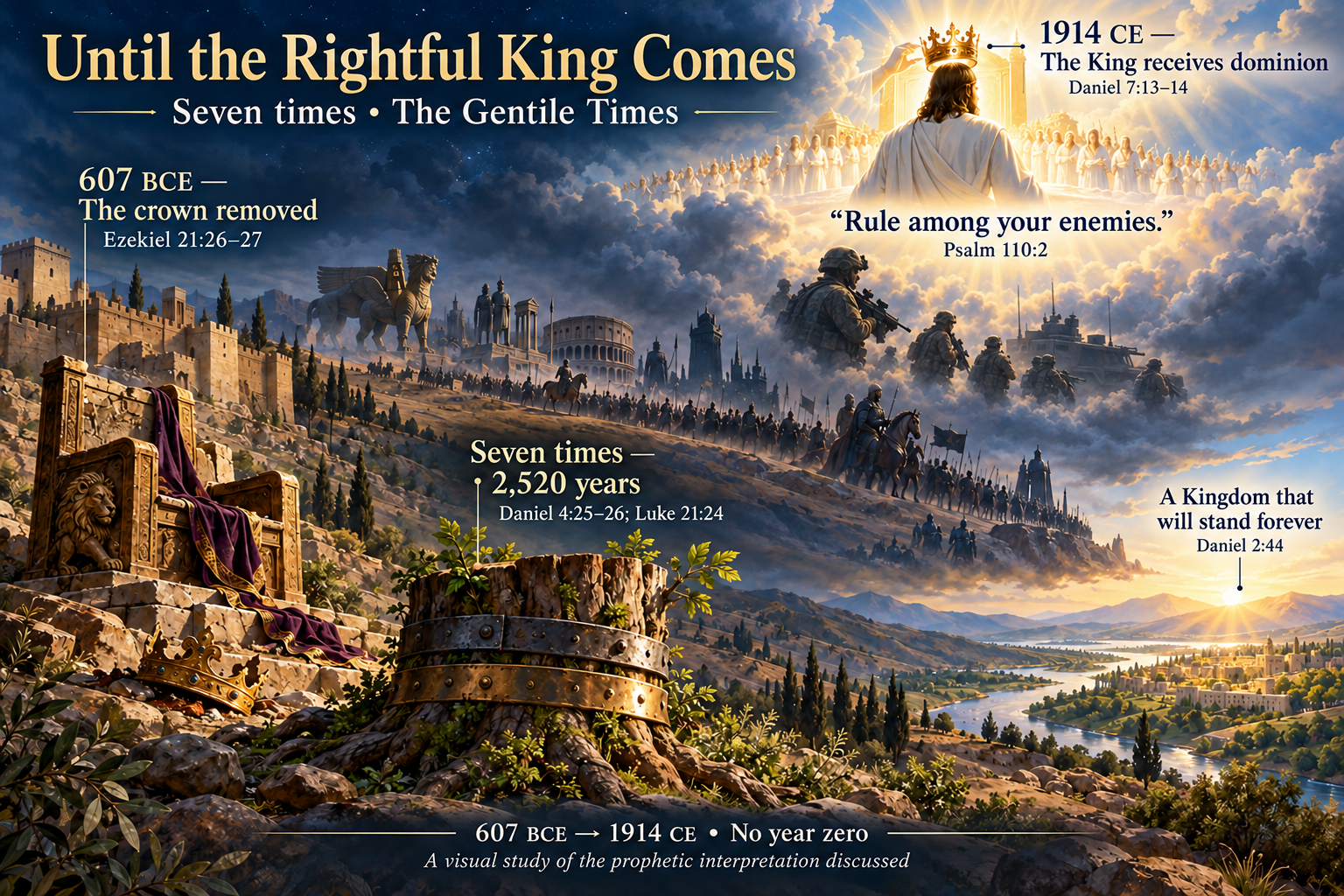
The seven Gentile times!
*** Joe *** Was Jesus's warning about the Gentile Times the first mention of it?
*** Hal *** The first explicit mention of “the times of the Gentiles” is Jesus’ statement in Luke 21:24. But earlier Scriptures describe related events:
Ezekiel 21:25–27: Israel’s ruler loses his crown until the one with the rightful claim comes.
Daniel 4: A king’s rulership is interrupted for “seven times,” demonstrating God’s authority over human kingdoms.
Daniel 7:13–14: One like a son of man receives dominion over all nations.
One distinction: Daniel 4 does not explicitly call its “seven times” the Gentile Times. Connecting those passages—and calculating an ending in 1914—requires interpretation; Jesus did not state that calculation in Luke 21:24.
*** Joe *** considering the seven time and the gentile times as one and the same, can you consturuct the theme of a bible study from it quoting the bible verses used?
*** Hal *** Theme: God permits Gentile rulership for an appointed time, then gives the Kingdom to Jesus Christ.
Taking Daniel’s “seven times” and Jesus’ “times of the Gentiles” as referring to the same period, the study can follow this thread. Quotations below are from the World English Bible, with the divine name shown as יהוה
1. Israel’s earthly throne with the Davidic line of Kings represented God’s rulership.
1 Chronicles 29:23
23 Then Solomon sat on יהוה's throne as king instead of David his father, and prospered; and all Israel obeyed him.
Solomon occupied a human throne, yet Scripture calls it יהוה. This establishes why the overthrow of that kingdom matters.
2. That rulership would be interrupted until the rightful king came.
Ezekiel 21:26–27
26
The Lord יהוה says:
“Remove the turban, and take off the crown! This will not be as it
was. Exalt that which is low, and abase that which is high.
27
I will overturn, overturn, overturn it. This also will be no more,
until he comes whose right it is; and I will give it.”
The crown’s removal was not the abandonment of God’s purpose. God promised to give rulership to the one entitled to receive it.
3. Daniel’s “seven times” emphasize that God determines who rules.
Daniel 4:17
17 “‘The sentence is by the decree of the watchers, and the demand by the word of the holy ones, to the intent that the living may know that the Most High rules in the kingdom of men, and gives it to whomever he will, and sets up over it the lowest of men.’
Daniel 4:25–26
25
“You shall be driven from men, and your dwelling shall be with the
animals of the field. You shall be made to eat grass as oxen, and
shall be wet with the dew of the sky, and seven times shall pass over
you, until you know that the Most High rules in the kingdom of men,
and gives it to whomever he will.
26
Whereas they commanded to leave the stump of the roots of the tree,
your kingdom shall be sure to you after you know that Heavens rules.”
The immediate fulfillment concerned Nebuchadnezzar. The interrupted rulership and preserved stump also illustrate that God’s right to rule remains secure throughout the appointed interval.
4. Jesus identifies a limit to Jerusalem’s trampling by the nations.
Luke 21:24
24 “They will fall by the edge of the sword, and will be led captive into all the nations. Jerusalem will be trampled down by the Gentiles, until the times of the Gentiles are fulfilled.”
The key word is “until.” Gentile domination has an appointed limit. On the premise of this study, Jesus’ statement identifies the same interval illustrated by the seven times.
5. Jesus is the promised heir to David’s throne. It is his legal right!
Luke 1:32–33
32
“He will be great, and will be called the Son of the Most High. The
Lord God will give him the throne of his father David,
33
and he will reign over the house of Jacob forever. There will be no
end to his Kingdom.”
This identifies Jesus as the rightful king anticipated in Ezekiel’s promise.
6. The Kingdom is given to him from heaven.
Daniel 7:13–14
13
“I saw in the night visions, and behold, there came with the clouds
of the sky one like a son of man, and he came even to the ancient of
days, and they brought him near before him.
14
Dominion was given him, and glory, and a kingdom, that all the
peoples, nations, and languages should serve him. His dominion is an
everlasting dominion, which will not pass away, and his kingdom one
which will not be destroyed.”
The study’s central question becomes: When the appointed time of Gentile domination ends, who receives authority over the nations? These passages direct attention to Jesus Christ.
7. His rule brings the replacement of human kingdoms.
Daniel 2:44
44 “In the days of those kings the God of heaven will set up a kingdom which will never be destroyed, nor will its sovereignty be left to another people; but it will break in pieces and consume all these kingdoms, and it will stand forever.”
The thread is: God’s representative throne ⟶ its overthrow ⟶ an appointed interval ⟶ the rightful King ⟶ God's everlasting Kingdom restored to earth.
That develops the theme without yet calculating a date. Establishing 1914 would require a separate examination of the starting date and how the “seven times” are measured.
*** Joe *** Would you construct that now?
*** Hal *** Bible study theme: Do the seven times point to 1914 as the end of the Gentile Times?
Continuing with your premise that Daniel’s “seven times” and Jesus’ “times of the Gentiles” describe the same period, here is the calculation and its scriptural basis. Quotations are from the World English Bible, with the divine name shown as יהוה.
1. The crown is removed until the rightful King comes.
Ezekiel 21:27
27 “I will overturn, overturn, overturn it. This also will be no more, until he comes whose right it is; and I will give it.”
This supplies the study’s starting event: the overthrow of the kingdom represented by Jerusalem and its Davidic throne. Using 607 BCE as the date of that overthrow, the proposed interval of the Gentile Times begins there.
The distinction to preserve is that the verse identifies the event; it does not itself supply the date 607 BCE.
2. Daniel describes an interruption lasting seven times.
Daniel 4:25
25 “You shall be driven from men, and your dwelling shall be with the animals of the field. You shall be made to eat grass as oxen, and shall be wet with the dew of the sky, and seven times shall pass over you, until you know that the Most High rules in the kingdom of men, and gives it to whomever he will.”
Nebuchadnezzar’s experience demonstrates the central truth: the Most High determines who receives rulership. Applying the seven times to the longer interruption of God’s representative kingdom is the interpretive connection on which this study proceeds.
3. Revelation provides a way to compare “times” with days.
These two verses describe the woman’s protection in the wilderness:
Revelation 12:6
6 The woman fled into the wilderness, where she has a place prepared by God, that there they may nourish her one thousand two hundred sixty days.
Revelation 12:14
14 Two wings of the great eagle were given to the woman, that she might fly into the wilderness to her place, so that she might be nourished for a time, and times, and half a time, from the face of the serpent.
Reading “a time, and times, and half a time” as three and a half times gives:
Period |
Corresponding days |
|---|---|
Three and a half times |
1,260 |
Seven times |
2,520 |
That establishes the proposed 2,520-day measure. Applying Revelation’s measure to Daniel 4 is another step in this understanding.
4. Why count those days as years?
Scripture sometimes expressly assigns a year to a symbolic day.
Numbers 14:34
34 “After the number of the days in which you spied out the land, even forty days, for every day a year, you will bear your iniquities, even forty years, and you will know my alienation.”
Ezekiel 4:6
6 “Again, when you have accomplished these, you shall lie on your right side, and shall bear the iniquity of the house of Judah. I have appointed forty days, each day for a year, to you.”
These passages establish scriptural examples of a day representing a year. Using that pattern for the seven times produces:
2,520 symbolic days — 2,520 years.
Neither passage explicitly commands that this conversion be applied to Daniel 4; that application belongs to the study’s interpretation.
5. Counting 2,520 years from 607 BCE reaches 1914 CE.
There is no year zero between 1 BCE and 1 CE.
Interval, measured between corresponding points in the year |
Years |
|---|---|
607 BCE to 1 BCE |
606 |
1 BCE to 1 CE |
1 |
1 CE to 1914 CE |
1,913 |
Total |
2,520 |
Thus, an interval beginning in the fall of 607 BCE ends in the fall of 1914 CE. Specifying fall requires establishing the season of the starting event separately.
6. Jesus says the Gentile Times will reach their fulfillment.
Luke 21:24
24 “They will fall by the edge of the sword, and will be led captive into all the nations. Jerusalem will be trampled down by the Gentiles, until the times of the Gentiles are fulfilled.”
On the study’s premise, 1914 marks the end of that appointed interval and the giving of royal authority to the rightful King.
7. Receiving royal authority does not require all enemies to disappear immediately.
Psalm 110:1–2 — WEB
1 יהוה
says to my Lord, “Sit at my right hand, until
I make your enemies your footstool for your feet.”
2 יהוה
will send out the rod of your strength out of
Zion. Rule among your enemies.
This provides a scriptural basis for distinguishing the King’s exercise of authority among enemies during their final defeat. It does not, by itself, date either event.
The proposed conclusion: If the seven times represent the Gentile Times, if their 2,520 days represent years, and if the interval begins in 607 BCE, the calculation reaches 1914 CE. The arithmetic is definite; the identification of the period, the day-for-year application, and the starting date are the premises that must be established to support that conclusion.
*** Joe *** You don't think WWI starting in 1914 and what has happened since might support the conclusion?
*** Hal *** Yes, Joe. World War I beginning in 1914, followed by the upheavals since, can support that conclusion. I should have included that evidence in the study.
The reasoning has two parts: the prophetic calculation points to a year; events are then examined for correspondence with what Scripture describes. War, food shortages, pestilences, and distress among nations are relevant passages to consider—Matthew 24:7–8; Luke 21:10–11 & 25–26; Revelation 6:4–8.
The distinction is between support and proof. Those events can strengthen the interpretation, though they do not independently establish the 607 BCE starting date or the day-for-year application.
Your argument therefore includes more than arithmetic: the calculated year coincides with an extraordinary historical turning point. That deserves consideration.
